


-
-
-
 Mir, Krasnoarmeyskaya St., 2
-
Museum ticket office is open:
 Понедельник-воскресенье с 10:00 до 18:20
Прыбіральні, размешчаныя ў музеі, адкрыты з 10:00 да 18:20Прыбіральні, размешчаныя на тэрыторыі комплексу, адкрыты: Пн-Чц з 10:00 да 19:00 Пт-Нд з 9:30 да 19:30
-
 +375 (1596) 36-2-70 Museum
+375 (1596) 36-2-92 Hotel
-
 Version for visually impaired
-
Museum ticket office is open:
Понедельник-воскресенье с 10:00 до 18:20
Прыбіральні, размешчаныя ў музеі, адкрыты з 10:00 да 18:20Прыбіральні, размешчаныя на тэрыторыі комплексу, адкрыты: Пн-Чц з 10:00 да 19:00 Пт-Нд з 9:30 да 19:30
-
+375 (1596) 36-2-70 Museum
+375 (1596) 36-2-92 Hotel
-
 Version for visually impaired
- Buy ticket


 MENU
МУЗЕЙ
ПОСЕТИТЕЛЯМ
О КОМПЛЕКСЕ
● International recognition
INTERNATIONAL RECOGNITION
OF THE MIR CASTLE COMPLEX
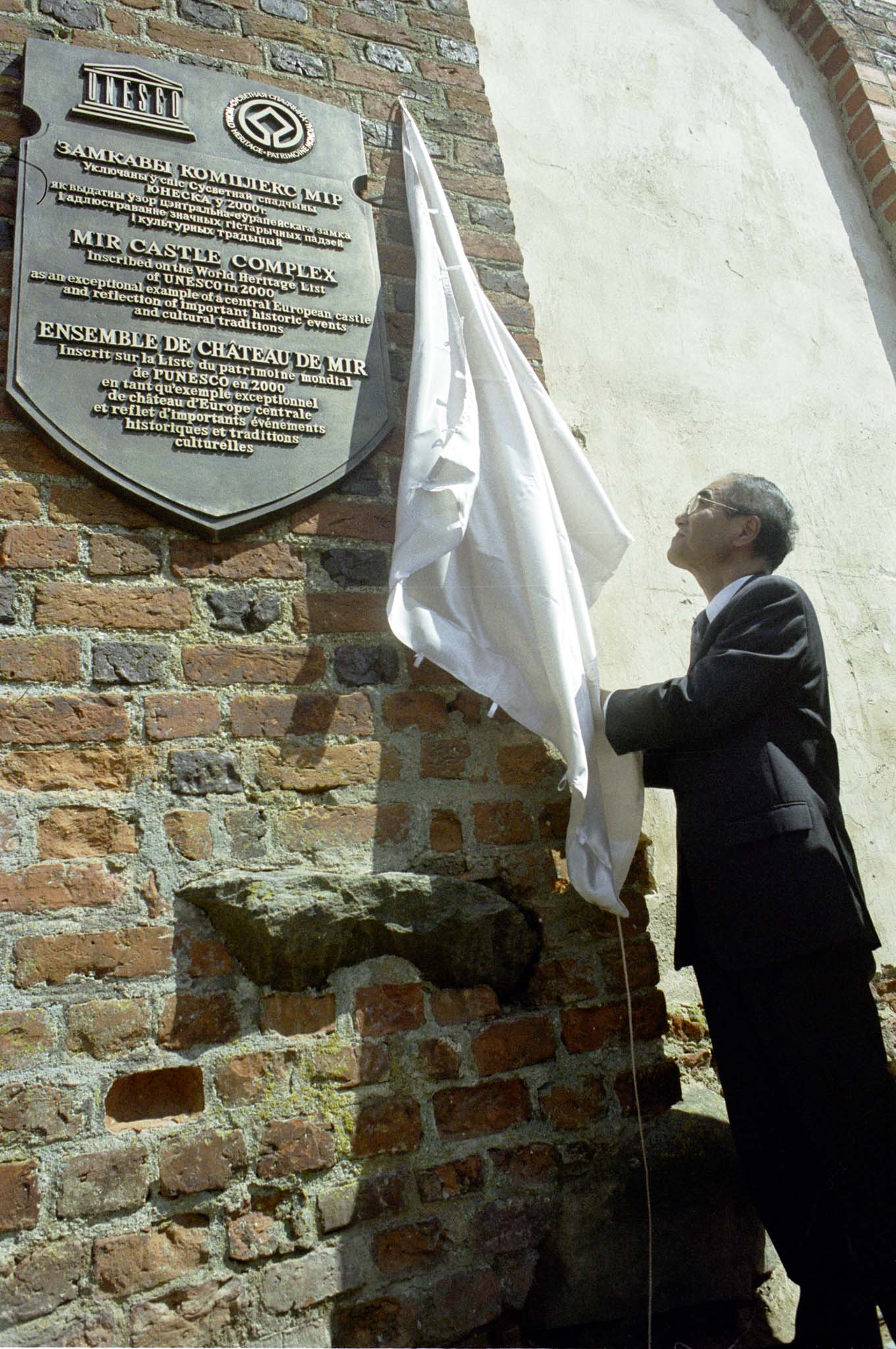
Every tourist visiting Mir Castle will know that it belongs to the world's cultural heritage. On July 9, 2002, a solemn ceremony took place here to unveil a memorial plaque marking its inclusion in UNESCO's prestigious World Heritage List. The decision to inscribe Mir Castle on this list was made in November 2000 during a session of the UNESCO World Heritage Committee. Koichiro Matsuura also presented the certificate confirming Mir Castle's inclusion in UNESCO's World Cultural and Natural Heritage List.
In the photo: K. Matsuura at the unveiling of the memorial plaque at Mir Castle. Photo by Nikolai Petrov (SOURCE: BELARUSIAN TELEGRAPH AGENCY; BELTA, 2002).
The Mir Castle Complex is among the world's sites recognized as having "Outstanding Universal Value" under the 1972 World Heritage Convention. It was inscribed during the World Heritage Committee session held in Cairns, Australia, in 2000. Since then, the complex has become one of the national symbols of independent Belarus and gained international recognition.
All World Heritage sites share one common quality – Outstanding Universal Value (OUV) – meaning their cultural and/or natural significance transcends national boundaries and holds universal importance for present and future generations of humanity.
STATEMENT OF OUTSTANDING UNIVERSAL VALUE
Mir Castle is an integral part of the Mir Castle Complex. Located in the town of Mir by a small lake at the confluence of the Miranka River and its unnamed tributary, the castle was founded in the early 16th century (first mentioned in 1527). Completed in the early 17th century, it underwent several renovations over the centuries. The castle is an exceptional example of a Central European fortress, harmoniously blending Gothic, Renaissance, and Baroque influences. Its form reflects the region's turbulent political and cultural history.
Situated near Europe's geographical crossroads, it witnessed major European conflicts. Originally built in Gothic style by the Ilyinich family, it was later expanded by the Radziwills with Renaissance-style palace wings (including the Italian garden). After damage in 1655 and 1706, Baroque elements were added. The castle suffered during the Napoleonic Wars and remained ruined until the late 19th century when the Svyatopolk-Mirsky princes acquired it, creating a landscape park. Partial restorations in the 1920s-30s introduced Art Nouveau and Romantic elements. During WWII, it served as a Jewish ghetto. Major restoration began only in 1982, culminating in 2010 with its transformation into a museum complex with conference-halls and a hotel.
Integrity
All elements supporting the OUV are contained within the 27-ha property, including the castle, chapel-crypt of the Svyatopolk-Mirsky princes, gatehouse, ruins of the 19th-century palace, chapel, park, and lake. A 537.93-ha buffer zone exists. Preservation is satisfactory.
Authenticity
The site maintains high authenticity in location, materials, and design. The medieval town-castle relationship remains visible. Stone structures are well-preserved, though most wooden elements were lost. Restoration used traditional techniques, revealing original Gothic fragments like wall paintings.
Criteria for OUV
• Criterion (II):
Mir Castle demonstrates an exceptional example of central European castle architecture, showcasing the blending of different cultural influences (Gothic, Renaissance, and Baroque) in its design and layout.
• Criterion (IV):
The castle's form and appearance reflect the long history of political and cultural confrontation and coalescence in the region.
INTEGRITY AND AUTHENTICITY STATEMENT
Due to specific historical circumstances, the structures and facades of the entrance and southwestern towers of Mir Castle have not undergone later modernization.
The authenticity of Mir Castle's design as an outstanding architectural work - a rare and vivid testimony to a distinctive architectural tradition differing from both Western and Eastern styles - manifests in its integrity as an autonomous work of art. Shaped by evolving religious concepts, interfaith and political struggles during a pivotal period in defensive architecture development, while absorbing diverse cultural and artistic influences, the castle captivates with its human-scale proportions, plasticity and chromatic solutions despite its monumental size.
Several contemporary structural elements have been incorporated using modern technologies to ensure conservation and proper functioning of the building. These interventions have been deliberately made visually distinguishable.
The authenticity of the setting is preserved due to the arrested development of Mir settlement during capitalist industrialization (caused by its remoteness from railway networks) and throughout the socialist period.
Protection
The Mir Castle Complex (16th–20th centuries), comprising buildings, structures, spatial layout, landscape features, remnants of earthen fortifications, and water management elements, is registered as a Category "0" historical and cultural property in the State List of Historical and Cultural Values of the Republic of Belarus under code 410Г000317. This designation was established by Resolution No. 578 of the Council of Ministers of the Republic of Belarus dated May 14, 2007 "On the Status of Historical and Cultural Values" (National Register of Legal Acts of the Republic of Belarus, 2007, No. 119, 5/25167).
Pursuant to Article 1 of the Convention, the Mir Castle Complex is classified within the existing typology as a monument of cultural heritage (coordinates: 53°27'03.5"N 26°28'27.5"E).

